Polar Stratospheric Clouds:
Some clouds seem to glimmer with pearl-like hues, shining softly in the cold skies of the poles, while the majority drift in shades of white and grey. One of the rarest and most ethereally beautiful sky phenomena on Earth are polar stratospheric clouds, sometimes referred to as nacreous clouds.
Nacreous clouds are the spectral afterglow of the Northern and Southern skies, if auroras are their fireworks.
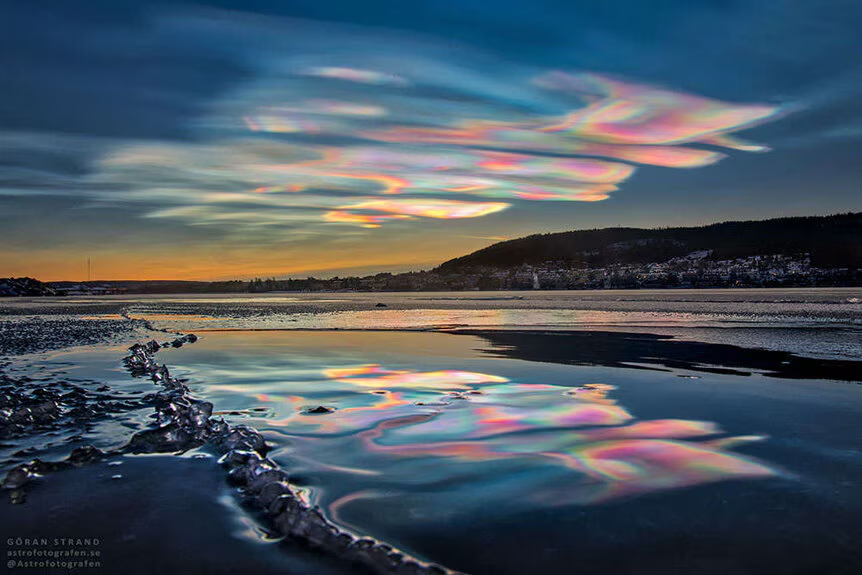
What Are Clouds in the Polar Stratosphere?
At elevations of 15 to 25 km (9 to 16 miles), which is significantly higher than most normal weather clouds, nacreous clouds arise in the stratosphere. Supercooled water and nitric acid droplets, which exist at temperatures lower than -78°C (-108°F), make up the majority of their composition.
Their ability to scatter sunlight in a way that creates delicate, opalescent colors—pink, blue, green, and violet—that mimic the interior of a seashell is what gives them their striking visual appeal. The Latin term for mother-of-pearl, “nacre,” is really where the word “nacreous” originates.
How and When Do They Form?
Unlike ordinary clouds, nacreous clouds form only under extreme cold and specific conditions found near the poles.
Requirements:
- Polar winter (from late November to February in the Arctic; May to August in the Antarctic)
- Very low temperatures (below −78°C)
- Sunlight just below the horizon — they’re best seen during twilight, when the Sun is below the horizon but still illuminates the high stratosphere.
They often appear just after sunset or before sunrise, when the lower atmosphere is dark but the upper layers are still sunlit — causing them to glow eerily against the darkening sky.
Where Can You See Them?
These clouds are rare and confined to polar and subpolar regions, especially during the coldest months of the year.
Best places:
- Scandinavia (Norway, Sweden, Finland)
- Scotland (occasionally)
- Iceland
- Northern Canada
- Alaska
- Antarctica – most consistent, but inaccessible for most people
Beyond Beauty – A Connection to the Ozone Hole
Polar Stratospheric Clouds are beautiful, but they have a sad side: they contribute to the ozone layer’s depletion.
Here’s how:
These clouds serve as a surface for chemical processes that produce chlorine, which depletes the ozone layer, from innocuous chemicals.
The well-known Antarctic ozone hole is caused by this chlorine, which is activated when sunlight returns to the polar stratosphere and starts to degrade ozone molecules.
Therefore, nacreous clouds serve as a visible reminder of the brittleness of our environment even though they resemble floating opals.
The rarest gems in the sky are polar stratospheric clouds, which combine atmospheric science with natural artistry. They are captivating to see, but they also convey a deeper message about change, chemistry, and climate.
Therefore, if you ever find yourself in the extreme north or south under a chilly twilight sky, don’t limit your search to auroras. You have just witnessed one of the rarest and most enigmatic wonders on Earth. Look for a ghostly, shimmering veil draped across the heavens.
They float like pearls in the twilight… beautiful, silent, and strangely powerful.